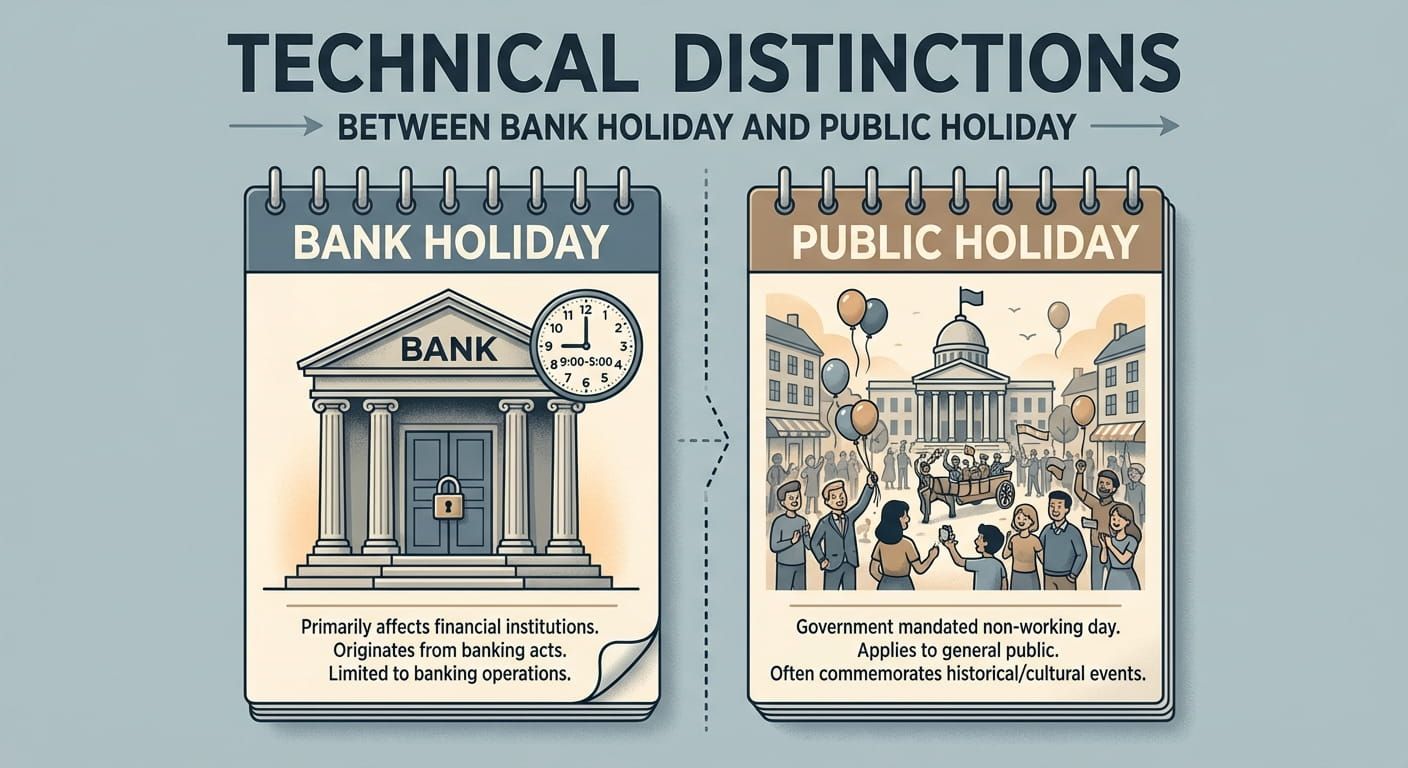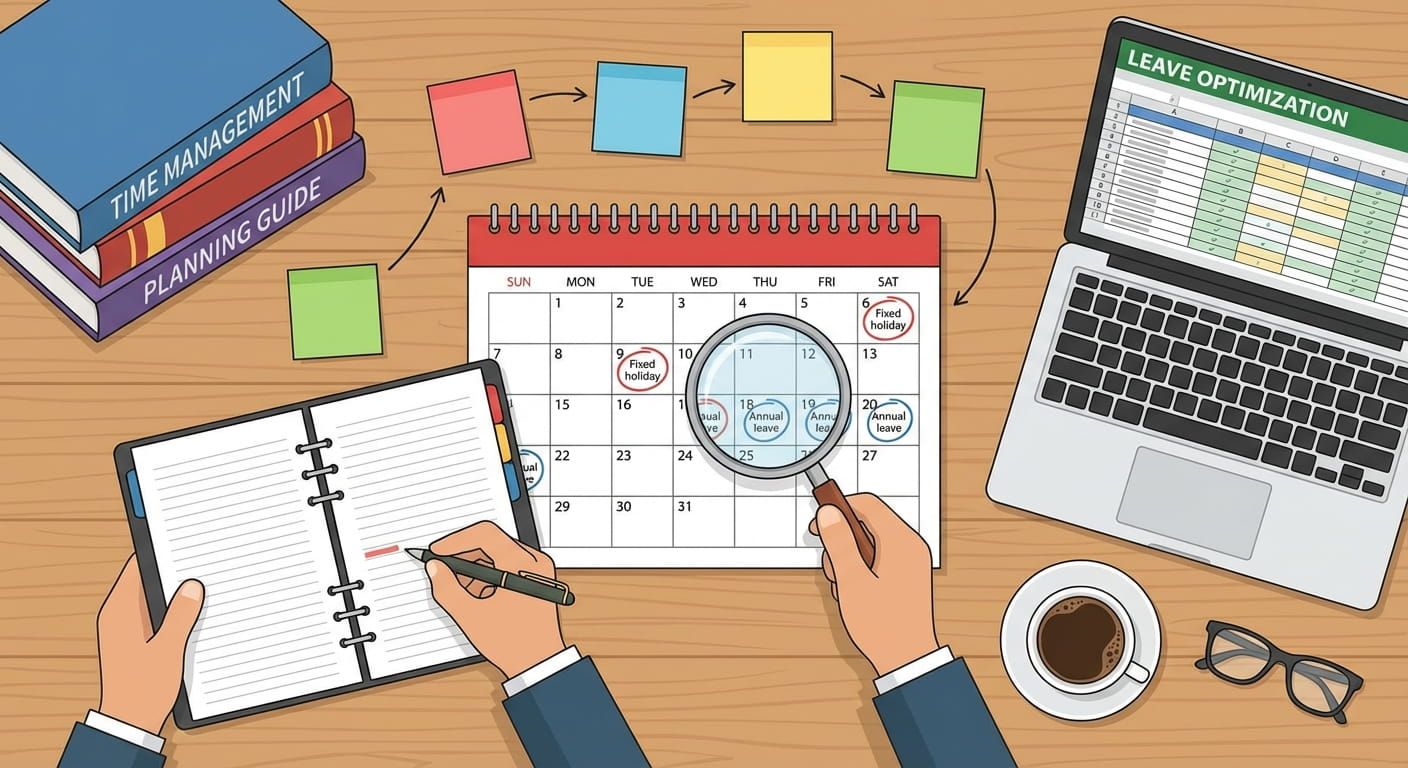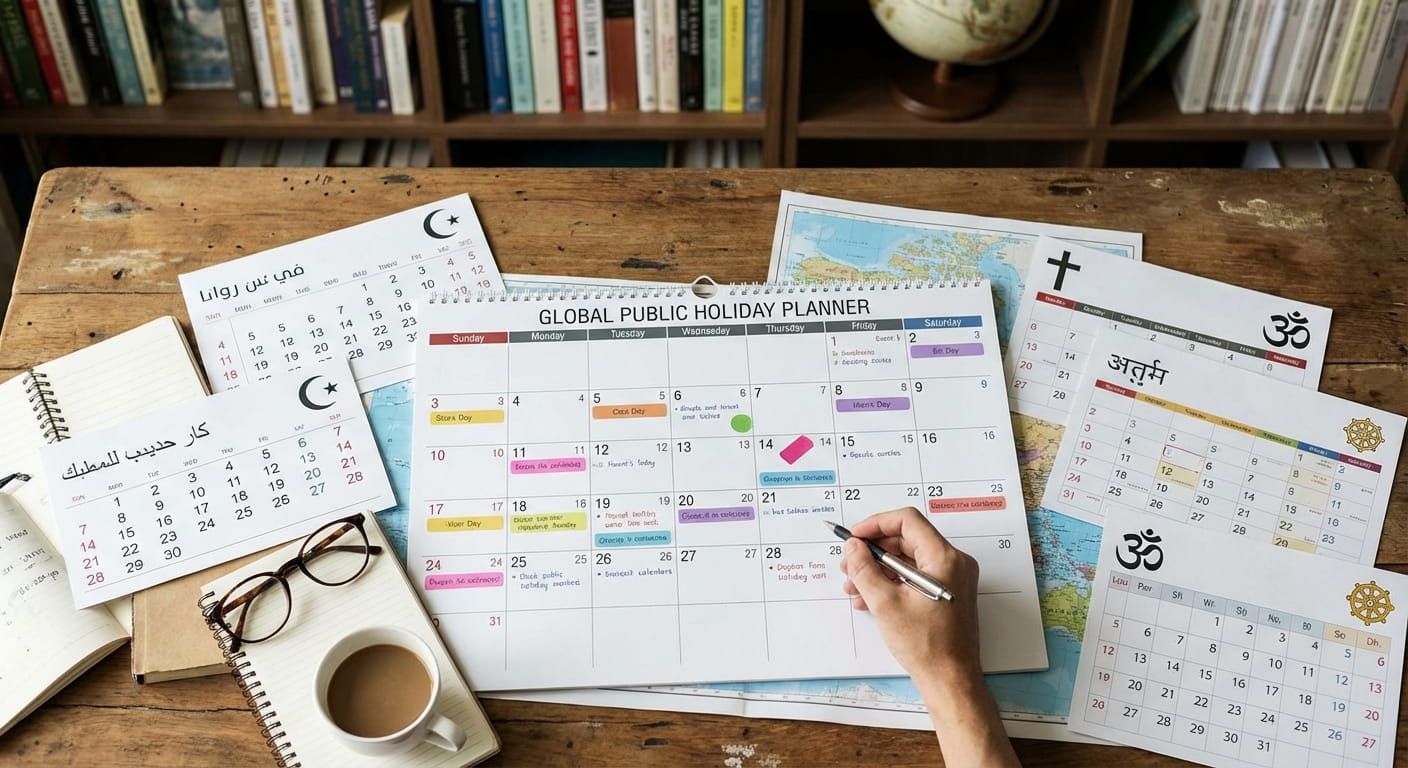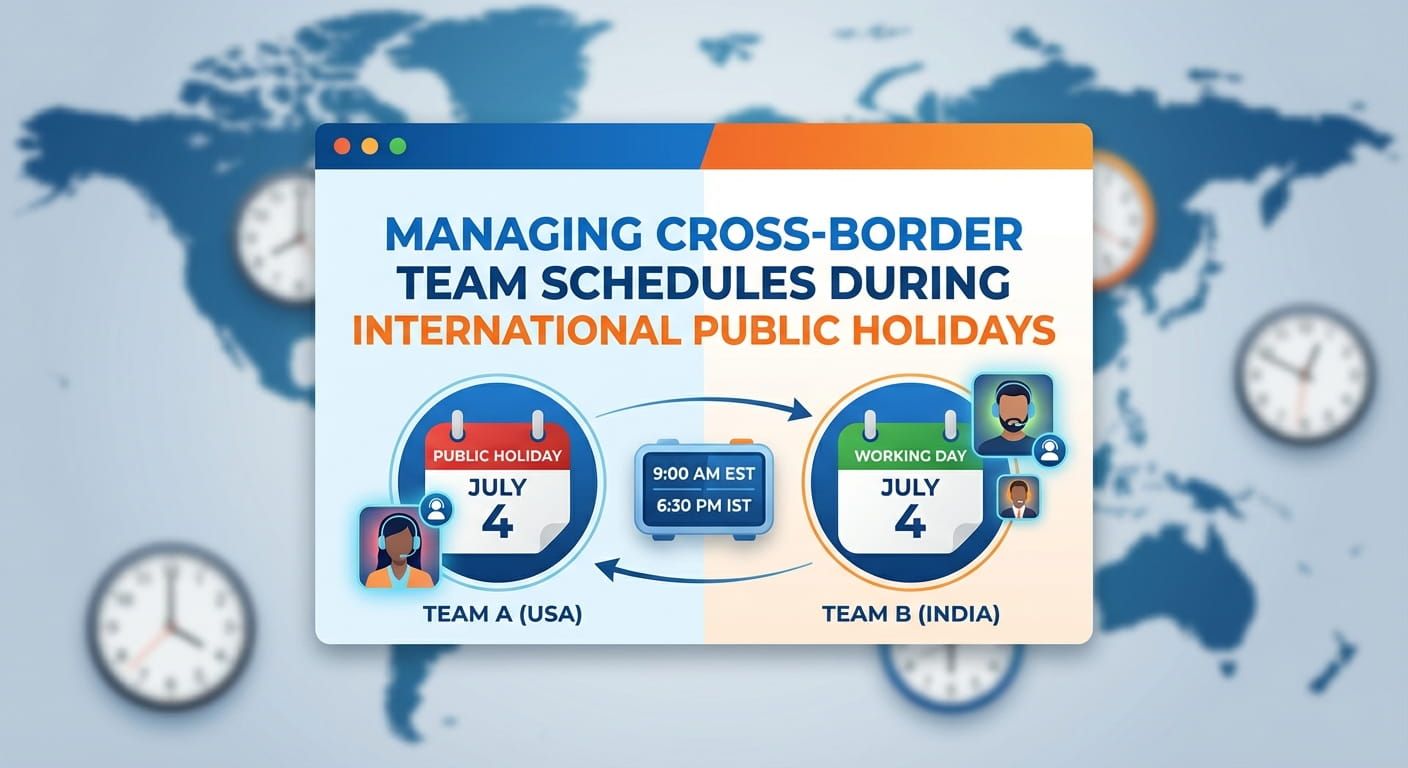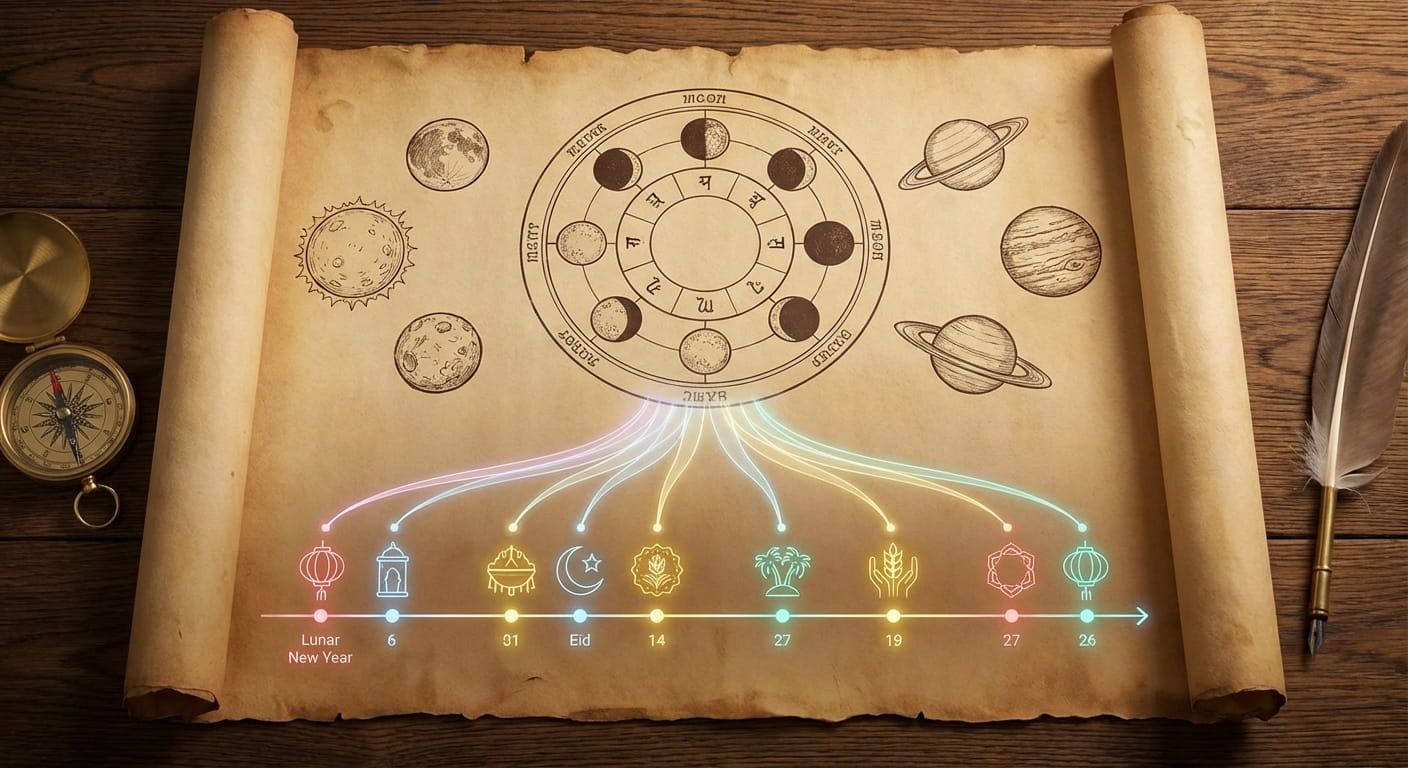
A holiday can feel familiar, then arrive on a totally different date the next year. That shift usually traces back to the Moon. Lunar and lunisolar calendars set months by lunar phases, then governments translate those dates into the Gregorian calendar for public holiday lists. This guide on holidays info explains how that translation works, why dates can vary by one day between countries, and what to look for when you plan travel or team schedules.
If you want a fast sense of what is coming soon, scanning holidays directory shows upcoming holidays across countries with dates and names. To see how a single place lays out the next few observances, checking Singapore holidays gives an example of the format you will meet throughout the site.
Lunar based public holidays move because lunar months are about 29.5 days, and a lunar year does not match the solar year used by the Gregorian calendar. Purely lunar systems drift through seasons over time. Lunisolar systems add an extra month in some years, keeping festivals in a seasonal window. Governments publish public holiday dates using calculation rules, official tables, and sometimes Moon sighting confirmation. Time zones, sunset based day boundaries, and observed day policies can shift the day off work by one day.
Test your lunar calendar instincts
What a lunar calendar really measures
A lunar calendar measures months by the Moon’s repeating cycle. The key unit is the synodic month, the period from one new Moon to the next new Moon. That cycle is a little under 29.6 days on average. Because calendars need whole days, lunar months are usually 29 or 30 days. Some systems use a repeating pattern. Some use calculations. Some follow observation practices.
The movement of public holiday dates starts here. Twelve lunar months add up to roughly 354 days. The solar year is about 365 days. This gap is close to eleven days. In purely lunar systems, the calendar steps earlier against the Gregorian calendar almost every year. That is why some holiday names visit different seasons over time.
The Moon influences public holidays far beyond one region. National calendars often combine fixed civil holidays with moving lunar holidays. Your work schedule might rely on a single list, yet the list may contain multiple timing systems underneath. Understanding those systems helps you plan without stress.
Purely lunar versus lunisolar calendars
Two Moon based approaches dominate public holiday timing. One is purely lunar. The other is lunisolar. The difference explains whether a holiday drifts across seasons or stays near the same part of the year.
Purely lunar calendars
A purely lunar calendar counts months by the Moon and does not insert extra months to stay aligned with the solar year. The year is shorter. That shortness stacks up year after year. A holiday anchored to a month and day in that system will move earlier in the Gregorian calendar, year after year.
This creates a recognizable rhythm. People often describe it as an eleven day annual shift on average. The exact landing day can look different because the Gregorian calendar has months of different lengths and includes leap days. Still, the direction is consistent. It keeps stepping earlier.
Lunisolar calendars
A lunisolar calendar uses lunar months, then adds an extra month in some years to stay aligned with seasons. That extra month is called a leap month. It acts as a reset that prevents long term seasonal drift.
A lunisolar holiday still moves in the Gregorian calendar, sometimes by weeks. Yet it stays within a seasonal window. Over decades, it does not roam across every season the way a purely lunar holiday can.
Why lunar based public holidays shift each year
Public holidays must be listed as civil dates for practical reasons. Employers need them. Schools need them. Transport systems need them. Yet the holiday rule can be defined in a different calendar. That mismatch is what you see as movement.
Here is the short version, in one paragraph with bullet points for easy reading:
- Lunar months are 29 or 30 days, not fixed to the Gregorian month pattern.
- A lunar year and a solar year are different lengths, creating drift in purely lunar systems.
- Lunisolar systems insert a leap month in some years, keeping seasonal alignment while still shifting civil dates.
- Time zones can place the same astronomical moment on different civil dates.
- Sunset based religious days can map awkwardly onto midnight based civil days.
- Observed day policies can shift the day off work even when the festival date is clear.
How the start of a lunar month is decided
Most confusion about lunar holiday dates is really confusion about month starts. A lunar month has to start somewhere. Different traditions choose different rules. Those rules are consistent within that tradition, but they can differ between countries and communities.
New Moon as an astronomical moment
A new Moon is an astronomical event. It happens at a precise instant. Yet it is not visible. That is why many traditions do not treat the new Moon instant as the practical start of the month.
First visible crescent as a practical marker
Many traditions use the first visible crescent after the new Moon. This makes intuitive sense, you can see it. Yet visibility depends on location, horizon, weather, and timing after sunset. One place might see the crescent on one evening. Another place might see it the next evening. That difference can change the civil date.
Calculated visibility rules
Some calendars use calculated rules that approximate visibility without relying on a live sighting. That gives planners more stable schedules. It also gives a single national standard. Still, different calculation standards exist, so two countries can use different results even with the same general approach.
Why sunset matters more than many people expect
Some religious days begin at sunset. Civil days begin at midnight. That mismatch means a holiday can begin on one civil date in the evening and continue into the next civil date. Public holiday lists must decide which civil date counts as the day off work. Some choose the civil date that contains the main daytime observance. Some choose the civil date that contains the sunset start. Both choices can be reasonable inside local norms.
Who confirms the date in public life
A public holiday is not only a tradition. It is a legal instruction to close offices, adjust pay rules, and shift services. That legal layer needs an authority. The authority differs by country and sometimes by holiday.
National calendars and official notices
Many governments publish annual holiday lists, often through an official calendar or a ministry notice. In these lists, some dates are fixed and some are marked as subject to confirmation. That phrase is a clue. It signals that observation rules or late stage declarations might adjust the date by a day.
Religious councils and formal declarations
In some places, religious authorities play a formal role in declaring month starts. The civil government then turns that declaration into a public holiday statement. In other places, the government sets the date by calculation and publishes it directly.
Regional variation inside a country
Large countries can have regional holiday rules. Some regions recognize additional observances. Some regions follow different day off policies. A country page can show the national picture, while local rules can add details. That is normal. It is also why planning across regions benefits from checking the right jurisdiction.
A clear view of calendar types and planning reliability
This table is built for planners. It answers one main question. How stable is the date, and what kind of change should you expect.
| Calendar approach | How months are set | Season behavior | Common publication method | What to expect |
|---|---|---|---|---|
| Purely lunar | 29 or 30 day months by sighting, calculation, or pattern | Long term drift through seasons | Predicted lists plus confirmation in some places | Year to year movement, plus possible one day adjustment |
| Lunisolar | Lunar months with a leap month in some years | Stays in a seasonal window | Often calculable and published far ahead | Movement inside a window, usually more predictable |
| Solar calendar with lunar marker | Civil year is solar, a holiday uses a lunar phase rule | Season stable, date varies within a range | Standardized rules and annual publication | Stable for planning, small variation year to year |
| Fixed civil dates | No lunar component | No movement across years | Published far in advance | Highest reliability |
The step by step path from lunar rule to day off work
A lunar holiday becomes a public holiday date through a short chain of decisions. You can use this chain to predict where uncertainty might appear. You can also use it to understand why two sources can disagree without anyone being careless.
- The holiday is defined in its source calendar. It might be the first day of a lunar month, the tenth day, the fifteenth day, or a lunar phase moment.
- The month boundary is determined. A system uses a calculated instant, a calculated crescent rule, or a sighting based rule.
- The date is mapped into local civil time. Time zone rules and local sunset boundaries can place the start on different civil dates.
- The state defines the legal public holiday. The government chooses the day off work, the name, and the number of days.
- Observed day policy is applied. Weekend shifting, substitution days, and bridge day practices can move the day off work.
Why one day differences happen between countries
One day differences are common. They happen for reasons that are easy to miss if you only look at the printed date. Below are the most common causes, explained in plain language.
Different definitions of the month start
One country might use a calculated month start at a defined astronomical instant. Another might use a crescent visibility rule. Another might follow a formal sighting practice. These approaches are not interchangeable, and they can produce different civil dates.
Time zones change the civil date of the same moment
A new Moon instant is one moment worldwide. It lands on different clock times in different places. A moment that falls after midnight in one country might still be before midnight elsewhere. That alone can push a lunar month start onto different civil dates.
Sunset based days meet midnight based calendars
Many religious days begin at sunset. A public holiday day off is usually defined as a civil day that runs midnight to midnight. The mapping between these day boundaries can move the day off work by one day, even if everyone agrees on the underlying religious start.
Forecast dates versus confirmed dates
Some lists are published early as expected dates. Later, an official statement confirms the final date. A one day change can be a normal update rather than a correction of an error.
How lunisolar calendars keep festivals near their seasons
Lunisolar calendars solve a problem that purely lunar calendars accept. The problem is seasonal drift. A lunar year is shorter than a solar year. Without correction, a festival that is meant to happen in a season would slowly move away from it.
The correction is a leap month. A lunisolar system inserts an extra month in some years. That extra month keeps lunar months aligned with seasons over the long run. The details vary by tradition. The result is consistent. Festivals stay in a seasonal band rather than cycling across all seasons.
Leap months can make the calendar feel like it jumps. That is because the correction is a larger adjustment than the yearly drift you see in purely lunar systems. Still, the jump has a purpose. It keeps the seasonal position stable across decades.
Observed days and substitute days
Even after a holiday date is set by lunar rules, the day off work can be moved. Many countries grant a substitute day if a holiday falls on a weekend. Some shift the day off to Monday. Some choose the next weekday. Some add an extra day. Some create multi day blocks around major festivals to manage travel demand.
This is why a holiday listing can show two ideas at once, the festival date and the observed public holiday. If you plan travel or deadlines, the observed day is often what matters most. If you plan cultural events, the festival date can matter more. Both can be correct, they answer different needs.
Examples of lunar influence in real country holiday lists
Examples work best when you can see how the same site presents different countries. Country pages show how lunar linked holidays sit alongside fixed civil holidays. The goal here is not to rank countries, it is to show different planning patterns.
Malaysia holidays and a mixed system
A mixed system is common. Civil holidays and national days are fixed. Major religious observances often follow lunar calendars. On a planning level, this means part of the year is predictable far ahead, and part of the year can move each year. Looking at Malaysia holidays helps you see that blend in a practical list.
Saudi Arabia holidays and close attention to lunar observances
In countries where lunar observances play a major role, the year to year movement is more obvious. It affects work closures and travel periods. These are the calendars where the one day buffer habit pays off most. Browsing Saudi Arabia holidays gives a clear look at how important observances are presented for planning.
India holidays and regional variety
Large and diverse countries often include regional public holidays. Some are based on lunar timing, some on local harvest cycles, some on civic dates. That variety can make planning feel complex, yet it also follows patterns once you separate fixed dates from moving dates. Scanning India holidays shows how many observances can coexist within one national context.
China holidays and lunisolar windows
Lunisolar festivals tend to stay within seasonal windows, yet their civil dates still move year to year. That movement matters for travel peaks and business cycles. Checking China holidays offers a direct view of how those dates are listed.
Japan holidays and a calendar built for modern planning
Some countries have holiday lists that are largely fixed, with a smaller set of culturally rooted observances in the background. These calendars can feel stable because many dates are fixed or tied to weekday rules. Still, the wider region and travel plans can be influenced by neighboring lunar holiday peaks. Looking at Japan holidays is a useful reminder that your planning world may span more than one calendar tradition.
Iran holidays and multiple calendar traditions
In some places, more than one calendar tradition influences public life. That can include solar based local calendars, lunar religious calendars, and global Gregorian civil usage. Seeing them side by side makes the idea of translation between calendars very concrete. Browsing Iran holidays shows how different timing systems can sit together in one national list.
A planner friendly checklist for reading any holiday entry
A holiday entry is a compact summary of choices. The fastest way to avoid confusion is to read it with a checklist. Here is the checklist people end up building after a few scheduling surprises.
- Is it a public holiday nationwide or limited to certain regions
- Is it one day or multiple days and do closures span weekends
- Is the date described as observed or a substitute day
- Does the holiday move each year which hints at lunar or lunisolar timing
- Is there language about confirmation which hints at sighting based practice
Signals that a lunar date might shift by one day
This is the part many people want most. If you are planning a deadline, a trip, or a product release, you want to know whether the date is locked. The table below summarizes the most common signals and how to handle them.
| Signal you might see | What it usually means | What to do |
|---|---|---|
| Subject to confirmation | Month start may depend on an official declaration | Keep a one day buffer for critical deadlines |
| Sighting language | Local observation traditions may be in play | Treat early dates as expected, check final notices close to the event |
| Observed day noted | Day off work may be shifted due to weekend policy | Plan closures using observed days, not only festival dates |
| Multi day holiday block | Public closures can extend for travel and administration | Expect slower services before and after the core holiday day |
The listicle that helps you predict holiday behavior
A lot of planning success comes from recognizing the behavior pattern, not memorizing astronomy. This listicle is a shortcut. Each item describes a pattern you can spot in a holiday list.
- Season drift pattern: the holiday shifts earlier each year and will eventually appear in every season.
- Season window pattern: the holiday moves year to year but stays in a seasonal range.
- One day variability pattern: the holiday is usually stable but can move by one day due to confirmation practices.
- Weekend substitution pattern: the day off work moves even if the holiday date is stable.
- Regional add on pattern: the country has a baseline list and regions add their own days.
- Cluster pattern: multiple holidays bunch together, creating longer closure periods and travel peaks.
- Bridge day pattern: a weekday between a holiday and weekend becomes a day off in practice or by policy.
Practical advice for travel planning around lunar holidays
Travel is where lunar holiday movement becomes very real. Airlines price around demand. Hotels sell out. Roads congest. Government services pause. Even small changes in dates can shift the busiest days.
These habits help most travelers:
- Check the holiday range, not only the holiday day, because closures can expand.
- Look for multi day observance blocks that create travel waves.
- Assume some services slow down the day before and the day after major festivals.
- For sighting based dates, keep flexibility for a one day shift in bookings when possible.
The quiet trick is to watch the next 30 days view, because last minute changes matter most there. That is a big reason Time.so highlights upcoming holidays in a short window, it matches how real people plan.
Practical advice for schools and workplaces
Schools and workplaces care about the day off work, not only the cultural date. Payroll needs the correct closure day. Lesson plans need stable term calendars. Customer support needs staffing.
These habits help teams:
- Mark moving holidays as moving in your internal calendar. A simple label avoids future confusion.
- Separate holiday date and observed day. The observed day is the staffing day.
- Use a one day buffer for sighting based systems. Set deadlines away from the edge.
- Plan for clusters. Multi day closures can change response times more than single days.
- Confirm the country rule, not the rumor. Different countries can treat the same holiday name differently.
Frequently asked questions
Do lunar holidays always move by about eleven days
Purely lunar holidays tend to move earlier by roughly eleven days per Gregorian year on average. The exact visible shift can vary because the Gregorian calendar has months of different lengths and includes leap days. Lunisolar holidays do not keep drifting earlier, because leap months keep them in a seasonal window.
Can software calculate lunar holiday dates perfectly
Software can calculate astronomical moments very precisely and can implement published calendar rules. What software cannot guarantee is a future administrative choice when tradition includes observation and a later declaration. In those cases, predicted dates are still useful, and confirmation remains part of the process.
Why do some lunar public holidays last several days
Some festivals are multi day by tradition. Others become multi day for public policy reasons, to support travel and family time. Sometimes governments align closures with weekends to reduce disruption.
Why do two sources disagree by one day
Common reasons include different month start definitions, time zone mapping, sunset based day boundaries, and forecast versus confirmed dates. A one day difference often disappears once you check the official list for the specific country and its observance policy.
A short glossary that makes the topic less slippery
A few terms keep appearing in conversations about lunar holiday dates. This glossary keeps the explanations grounded and usable.
- Synodic month: the Moon cycle from one new Moon to the next new Moon.
- New Moon: an astronomical instant that is not directly visible as a crescent.
- Crescent sighting: a practice that starts a month when the first thin crescent becomes visible.
- Lunar year: a year of twelve lunar months, shorter than a solar year.
- Lunisolar calendar: a lunar month calendar that inserts a leap month in some years to keep seasonal alignment.
- Observed day: the day off work assigned by policy, sometimes different from the festival date.
What to remember the next time the date changes
Lunar calendars do not make public holidays messy, they make them honest about how time is measured in different traditions. Public holiday lists are the bridge between sky based timing and modern civil scheduling. Once you know whether a holiday is purely lunar or lunisolar, and whether the date is calculated or confirmed by observation, the movement stops feeling mysterious. It becomes a pattern you can plan around.
Keep two ideas in mind. The festival date reflects the underlying calendar. The public holiday date reflects legal observance. Most surprises happen when those two are assumed to be identical. Treat them as related, not identical, and your calendar gets calmer immediately.